Saturday, September 22, 2007

Asher at the door

Asher, 13 months old


Asher's favorite station these days is on the steps just outside our front door. Here he is in typical pose in a picture taken this morning. For some variations on the theme, check out the other four images posted at:

http://flickr.com/photos/43927105@N00/

or

http://www.facebook.com/album.php?aid=22376&l=cea5c&id=551421211

Thursday, September 20, 2007

When it all floats away

It's raining in eastern Uganda. A lot. No prospect of slowing down. Yesterday BBC's website reported, "WFP has launched an $60m appeal for food aid to Uganda alone, where it estimates 1.7 m people will go hungry. North-eastern Uganda has lost most of its crops to flooding, after the heaviest rains in three decades." Sunday I was at the Bukedea district HQ where I saw the WFP lorries preparing to offload sacks of food for displaced people and many others who have lost all their food supply for the next six months--most of it rotted under standing water, just before it would have been ready for harvest. I estimate that there were at least a thousand people waiting for aid on Sunday where I was, and it may have been closer to 2,000. There's no safe drinking water and little or no dry firewood to boil what is contaminated. The malaria-carrying mosquito population is about to increase exponentially. This same scenario is repeated in many sub-counties and parishes in a number of eastern and northeastern parts of Uganda.

I talked on Sunday with a friend who is a district-level chairman in Bukedea and is helping to supervise relief measures in that area. He promised to send me copies of official counts of people affected by loss of houses, crops, animals and other properties.

Meanwhile the rain continues apace, extremely heavy here in Mbale yesterday and today again.

This is already a serious situation, and there's potential for it to get a LOT more so and to have devastating impact for months to come as people deal with fallout like persistent flood-related diseases and stark lack of food until the next chance to harvest some time next year.

Will you pray for these hurting people? Will you consider doing something to help? If so, drop me a note as a comment on this blog or email me at aliyense@yahoo.com -- (Ian Shelburne, Mbale Mission Team)

Friday, September 07, 2007

Back to Ogur & blessings of the rain

A couple of Sundays ago Leila, along with teachers Becca and Kimberly, joined me on a visit to Ogur Akano, in Lira district. I had been there once before, when we distributed food and other needed supplies to people who were displaced by rebel attacks in the area. That was about four years ago, and since then those people have spent most of the time in a camp for displaced people. It was good to see them back home again! They greeted us when we arrived with cheers and waving branches covered with leaves and flowers. Leila blogged her impressions of the day, complete with an array of images, here:

http://www.xanga.com/malaika_09/612389358/a-sunday-in-lira.html

(Just copy and paste that URL into your browser window and it should take you to Leila's article and pictures)

It's been RAINY in Mbale for many weeks now. This has kept the weather cool and the air clear of the dust and haze that rapidly accumulates when the rain stays away. And, the Great Artist does amazing sky- and mountain-scapes all around us. It can be quite a show:


Rainbow over Wanale mountain


Late afternoon sunlight splashed on clouds over Wanale after the rain

Thursday, August 16, 2007

Birthday 43 - Just to be Different

In the face of an alarming trend among the long-term male members of our mission team to cease having birthdays when they reach 28 or 29 years of age, I made it a point to turn 43 last month -- quite publicly. My children made the occasion festive by presenting me with some of life's finer things, such as Dr. Pepper (recently though expensively and sporadically available from certain Mbale retailers) and Bourneville dark chocolate:


Best of all, of course, was the love of family together -- how do you assign a value to a hug from Emily?


Another of the signal blessings of the day was the presence of some of our favorite people--the Reeves family--in Uganda for their first time ever.

Here's Jerry...


...and Kristine


...and oldest son Jordan, speaking computerese with our Leila


I think we had enough fun to give serious thought to having another birthday around the same time next year, whether or not my beleaguered colleagues are able to escape the temporal anomalies that are inhibiting their progress along the time line.

Wednesday, August 15, 2007

Milange, Mozambique

From 6 to 9 August I visited and taught in Milange, Mozambique, just a ten-minute bicycle-taxi ride from the Malawi-Mozambique border post at Muloza. For three of those days we met with men and women from churches in Milange and the neighboring districts. The group numbered 137 the first day, and by the end of the time there there were around 300 present.

I enjoyed the hospitality of Amos Jekete Suwande and his wife, who serve as Malawian missionaries in Mozambique. They took excellent care of me, and we had hours of pleasant visiting time with each other and with a number of Mozambican leaders who were attending the seminar sessions. I taught on principles for waging spiritual warfare, looking at Biblical texts from Genesis through Joshua, and from the books of Ephesians and James, primarily.


A view of the outside of the house where Jekete and his wife live, and where I stayed while in Milange


They divided the living room of the house with a sheet - we did our eating and visiting together on the near side and I slept on the other side.


Some of the students outside the church building where the seminar took place - notice all the bicycles under the mango tree beside the building.


Inside the church building during a break in the teaching

Saturday, June 23, 2007

Saturday out and about

Emily asked me several times today about taking a bird walk together. So, about midway through the afternoon we outfitted ourselves with binoculars and made a short round of our immediate neighborhood. There's a naturally swampy valley just down the slope from our house, where at various points little springs feed a tiny stream that runs down the middle of the valley. It's an excellent habitat for a variety of birds, and there's a plethora of flowering vegetation types, both wild and cultivated. We walked a short distance on two sides of this little wetland, and slightly more than half-way round met Jonathan and Luke coming to meet us from the direction of the house.

Here the three kids are half sitting next to a small spring, with cassava plants in the background, as they look across the way at some of the birds we spotted.


Not far from there we came across this black and white butterfly on a lantana bush (no idea what kind of butterfly it is).


A pleasant way to spend part of a Saturday afternoon together in Mbale.

Monday, June 18, 2007

Sunday in Soroti, Monday at Sisiyi

Emily, Luke, Jonathan, Nathanael and I visited the Soroti town church Sunday. Had about 30 people in attendance for the morning service, and afterward took a van-load of people 17 km down the road to a bridge across the western tip of Lake Bisina for some baptisms. Eight people were baptized, while the rest of us witnessed the event and sang songs as each person went into and came back out of the water.


Today, Monday, I took the kids back out to Sisiyi Falls, where we hung out with the Sheros last Monday. Enjoyed a lunch of samosas, chapatis, and mandazis (local fast foods), clambered around on the rocks for a while, then went on what Christopher Robin might have called an "expotition" some distance into the drier and wilder bush-and-savannah country to the east. Saw a lot of nice birds and beautiful countryside.


Tuesday, June 12, 2007

Monday at Sisiyi

Monday the three younger boys, Emily and I joined the Shero family on an expedition to one of our favorite get-away-and-play spots: Sisiyi Falls on the first terrace of Mount Elgon. It's a wonderland of waterfall, rocky stream (complete with frogs and crabs), trees of all shapes and sizes, and house-sized rocks to climb. Here are some pictures of our day there:


Tuesday, May 22, 2007

22 years

Danetta and I (and Asher) just got back from a delightful weekend at Mto Moyoni, a retreat center on the west bank of the legendary White Nile. Our time there was in celebration of the 22 years that we've been married and in anticipation of the rest of our odyssey together. A few pictures to give you an impression of a place that's worth returning to --


One of the serendipities of the weekend for me was stumbling across what is just about my favorite African flower blooming out on the peninsula that reaches into the Nile from Mto Moyoni's riverside park. Here it is, variously called flame lily or gloriosa lily, the national flower of more than one African nation:

Saturday, February 17, 2007

A riot of bougainvillea

Can you believe it? This picture was taken about 15 feet from our front door, right in our front yard. It's mostly a mix of three different colors of bougainvillea, with just an occasional scarlet hint from the flowers of an anonymous wild vine that intermingles delightfully with the bougainvillea and kei-apple hedge behind.


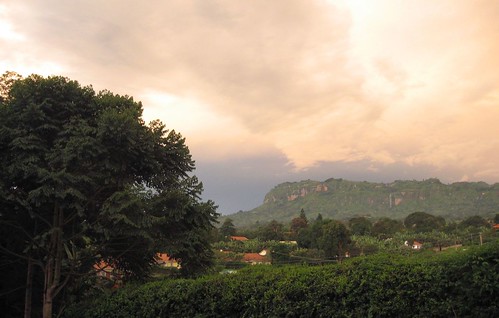
And here's a view of Wanale mountain with a rain shower partly obscuring the northeastern end. I took this shot standing right outside our front gate.

Boys

Our boys do fairly well keeping a positive attitude toward school (thanks in no small part, I'm sure, to the excellence of the teachers we have!)...but what they really live for is playing. Playing before, after, and even (when they can get away with it) during, school. They have typical boyish proclivities in their choice of how and with what to play. Other boys. Sticks. Knives and machetes. Tools. Fire. Rocks. Dirt. You get the picture.

For several weeks our boys are celebrating having an extra friend to hang out with -- Jeremy Varno, whose dad (and family) are here in Mbale to oversee some construction work for MTI and GNPI (Good News Productions International). Nathanael and Jeremy are nearly inseparable, making the most of every opportunity to do stuff together.


Jonathan puffing on a fire the boys tried to get going outside our gate...


....Nathanael in red and Jeremy in blue

Sunday, January 28, 2007

Asher, Emily & other "kids"

As you can see, Asher has started sitting up. We still stash a few cushions around him, but he's developing enough stability not to topple all that often any more. He tends to go over on his tummy more than any other direction, when he's trying to grab something that's just out of reach in front of him. Crawling is still in his future, though, so he ends up being a bit frustrated once he's no longer sitting and able to do as much with his hands.


Asher with Emily--a seriously cute combination (and I'm not even a grandparent!). We've been fostering Emily for three and a half years. Right now we're waiting for a court date to present our petition to the magistrate to formalize Emily's adoption into our family.


Last week we hosted students for three courses at Messiah Theological Institute. During one of our lunch breaks a couple of half-grown goats wandered into the classroom.


One of them, before being shooed out, hopped up on a bench and started to sample a student's folder. They do say a goat will eat just about anything!


Saturday, January 20, 2007

Getting around

There are several options for getting around in Uganda. The most common, by reason of economics, is what is sometimes called in Africa "route 11" -- one's own two feet. For the more prosperous (or less thrifty), however, other choices abound.

Most basic is the simple boda-boda (bicycle taxi), easily identified by a bright-colored cushion on the carrier rack mounted over the rear wheel (if you've ever ridden cushionless on this metal carrier on a rough road, this is greatly appreciated). Men ride astraddle, with each foot resting on a short piece of iron rebar welded to on each side of the rear axle. Women, typically, ride side-saddle (there's not much choice with a skirt on!). You can get a boda-boda ride from our neighborhood into town for the equivalent of $0.20 in U.S. currency.


The next step up is the motorcycle taxi (still referred to as a boda-boda, perhaps with the addition of the Swahili word pikipiki -- "motorcycle"). When considering climbing on the back of a pikipiki in Uganda, it is wise to note that there is considerably more risk of bodily harm if you are dodging through traffic in the capital, for example, than if you are meandering along a village path.


For those who prefer to be inside a vehicle and don't mind close--very close--companionship with fellow earthlings, there's the standard Toyota Hiace taxi, usually white with the government-mandated blue hatch pattern running horizontally around the body. Most of these are rated for 14 passengers, but, especially on rural routes, passengers configure themselves creatively to accommodate numbers up into the 20s. These taxis are locally called kamunyes, named for the yellow-billed kite, a scavenging bird that swoops down to pick up bits of food from the ground. The mechanical kamunye does the same with people--stopping frequently to pick people up from the side of the road. Kamunyes carry all manner of things besides humanity, including bunches of bananas, furniture, bicycles, mattresses, poultry and goats.


View of the "Old Taxi Park" in Kampala, where you can get rides to points east of the capital


Somewhat more comfortable, and statistically safer, are the big 50-passenger buses. At least one gets a seat to oneself, and most of the non-human cargo tends to ride in the cargo bay under, or on the roof rack over, the bus.


In areas where taxis are scarce, it is often possible to wave down a truck and climb on top of whatever else it's carrying and get from point A to point B, for a nominal fee. This can be more or less hazardous, of course, according to the nature of the existing cargo...one should think twice before perching atop the metal framework over the bed of a truck carrying a load of long-horned Ankole cows! I've often seen this done, and wondered how many puncture wounds have been sustained when a rider's balance failed on a rough road.


Beyond these means of transportation, some of us are blessed to have sufficient resources either to hire a vehicle as needed or even to purchase one for work-related and private purposes. In Uganda this is an expensive luxury, by the time one pays high fuel, maintenance, and tax rates.

As one goes about getting around in East Africa, there are encounters with quite a variety of traffic-types and road-side scenery. In Kampala, traffic gridlock is a frequent annoyance.


In the rural areas, one is more likely to get slowed down by a herd of cows in the road way.


A common sight all across the country are miniature fruit and vegetable markets along the sides of the road.


The dark side of transportation in East Africa is that these roads can be among the most dangerous in the world. Many roads are chronically full of potholes or too narrow for the traffic they have to carry. Compounding the risks are drivers of marginal or impaired competence, whether because of poor training, lack of experience, or inebriation. Poorly maintained vehicles frequently suffer tire blow-outs, brake-failure, or suspension/steering problems.

Our missionary community in Uganda is right now grieving the death, just a few days ago, of Adam Langford, a colleague from the Jinja mission team, who died in a vehicle accident. This kind of thing reminds us that travel on these roads does mean taking one's life in one's hands...or maybe better, putting one's life in God's hands. We appreciate those who keep us in prayer as we drive, or ride, on the roads of Africa.
Sunday, January 07, 2007

Sunday at Kabuna

This morning I drove out to Kabuna, about 45 minutes of travel time from Mbale town. There is a young church fellowship at Kabuna that invited me in December last year to visit them today. The people there have put up a basic shelter of rough-cut poles covered with papyrus-reed mats (that's the same papyrus that the Egyptians began using to make paper thousands of years ago--Kabuna is not far from an enormous papyrus swamp). The whole structure is not more than 25 feet long by 15 feet wide.

On the way to Kabuna I picked up George Gabiri and Yolam Waswikirye, leaders from two other churches in the same district, who came along to help me find the place and to offer some additional encouragement to this group of believers. We visit a lot of churches that are "off the beaten track"--but there aren't many that require so much twisting and turning on rudimentary village roads as this one. The route was not especially rough or dangerous, just extraordinarily windy and punctuated with junctions of miscellaneous trails every few hundred yards. I was impressed that George remembered the way perfectly and kept us from getting hopelessly lost.

Worship began shortly after we arrived and greeted those who were already there. Typically for churches in this area, there were four languages in frequent use during the service--Lugwere, Luganda, Kiswahili, and English, especially in the singing. One of the songs we sang today, in Luganda, goes something like this: "The name of Jesus brings us together, the name of Jesus is good/precious!" The worship leader interspersed the verses with the names of various tribes that Jesus brings together, such as Bagwere and Iteso, Bagisu and Baganda, etc. I preached from 1 Kings 13, the story of the man of God from Judah who spoke against the idol altar of Jeroboam and who, for his own disobedience, was killed by a lion that same day. While we were together two people, a widow and a young man, came forward to say that they wanted to give their lives to the Lord. We rejoiced to be able to pray for them and to entrust them to the local leaders who will teach them the basics of following Jesus, baptize them and walk alongside them as they start a new life.

There were around 20 adults and 20 children present. One, the widow I already mentioned, lost her husband only recently and has eight children to care for. There was a man there who has served more than ten years in the army, and has seen action in Uganda, Congo, and Sudan. He is from northern Uganda, but has relocated his family to Kabuna village to give them a place to live that is safe from the insecurity that has plagued the north for many years. His wife is originally from Kabuna, so she has the support of relatives when her husband is away with the military. We also had a young man who has finished his training to be an accountant, but cannot find a job. Sitting next to him was a teacher from a local school. And just in front of the two of them was an older woman who for many years practiced traditional medicine as a herbalist/witchdoctor, until she found the Lord.

I'm thankful that I could meet these brothers and sisters today, to try to encourage them in their faith, and certainly to be blessed myself by being with them.

Some of the folks at Kabuna church, relaxing after the main worship time as they wait for lunch (rice, millet bread, beans, chicken & soup)


A view through the open side of the shelter under which we worshipped--a mix of African traditional and Western elements that is typical in rural Uganda these days, with the garden area, banana tree and grass-thatched hut adjacent to a brick, cement and metal-roofed house

Tuesday, January 02, 2007

The blessing of neighbors

Leila with neighborhood friends Aby and Lydia

One of our Christmas family traditions is to carry plates of assorted cookies and candies around to friends in the Mbale community. Danetta spends a couple of days doing the cooking, baking and arranging, then some of us pile into a car and make the rounds to deliver the goods. As we were on our route a few days ago, it occurred to me that measuring wealth in terms of neighbors, we are rich indeed.

Our first stop was at Jeroen's farm, from where our regular supply of milk, cheese and yoghurt comes. Jeroen came to Uganda from the Netherlands years ago as a Roman Catholic lay volunteer, helping with agricultural projects in Kaberamaido, a couple of hours' drive north of Mbale. Along the way he married Petua, a delightful Ugandan lady, and together they eventually bought a farm on the edge of Mbale town where they run a dairy. You're always welcome at their house.

Next we stopped by the house where our boys' friend and schoolmate, Noah, lives with his family. They are from Germany. Here in Uganda Noah's dad works with patients in rehabilitative therapy at Kumi hospital.

Just down the road is a compound with two houses where we left plates for the Charles Howard and Dave Okken households. Charles serves as administrator for the children's orthopedic hospital in Mbale. Dave divides his time between Mbale and Nakalei, a two-hour drive into a real wilderness area, where he does preaching and discipling ministry among the nomadic Karimojong people. We are blessed to have them in our community.

Next we stopped by Robbie's place. He was not home, being busy with an operation to provide food for Christmas to a thousand or so widows in a slum area on the western edge of Mbale. Robbie hails from the UK, and he stays busy with a wide variety of community development projects in the name of Christ.

We drove on to the Eids' house, shaded by giant African mahogany trees. Yusef and Nada were among our first friends in Mbale, having been here since 1986. They are Palestinians, who came to Uganda from Lebanon. They operate a film-developing studio in town. Among the most hospitable people we have ever met, they frequently have us and other friends in the community over for supper (an unfailingly superb Lebanese menu) or to watch a movie together.

Then it was time to drop in on the Proctors, Orthodox Presbyterian missionaries who also happen to be our nearest neighbors (we share a back-yard fence, over which our two sets of kids routinely clamber back and forth over ladders propped on each side). These are quality people, the kind you want to have around you for the worst as well as the best of times.

On the other side of the neighborhood we visited the home of Parimal and Rani. They are Indian by nationality, but Parimal has spent all his life, more or less, in East Africa. A businessman, he also runs a car-repair shop and has done a lot of work on our vehicles over the years. Rani is a splendid cook. We've learned a lot more from her than we ever knew before about Indian cuisine!

Our next port of call was about four miles south of town on the Tororo road, where the Gibsons live. Their first set of children grown and on their own, they have adopted two other children, one of them a Ugandan orphan. Howard, originally from the Isle of Man, helps people here to make improvements in their agricultural methods. He is master of a wide variety of innovations in appropriate technology.

The Duffields, whose house we visited last on our route, left their first careers in Australia a few years ago and moved to Uganda. They have managed an orphan-sponsorship program and have helped develop a primary school and clinic during their time here. Besides that, they have adopted two lovely Ugandan girls who are good friends of our little Emily.

I almost forgot to mention Patrick and Helen--we didn't deliver to them, since one or two of their family had been over to visit and carried theirs home with them. Patrick, born here in Uganda, trained and practiced medicine in the UK and the US before bringing his family back to Uganda to build a hospital in his home village and start an array of other development projects. Their several children are close friends of our crew and spend a lot of time at each other's houses.

Neighbors like these--in addition to the most wonderful set of coworkers I can imagine--add extraordinary blessings to our lives as we enter a new year.

Lydia, Aby and Nathan with our Nathanael

Friday, December 15, 2006

Tying the knot in Namiyembe

A couple of weeks ago--on a Saturday, which is "the" day for weddings in Uganda--I headed for Namiyembe to officiate at a wedding ceremony. To "join the couple" is how they say it here. "Namiyembe" means "place of mangos," and one can see many a dark green mango-tree crown among the lighter greens of other trees and bushes and the greyish brown thatched roofs of local huts.

I've learned by experience that whoever drives a motor vehicle to a wedding ceremony, at least in rural areas of Uganda, also gets to dog-leg over to wherever the bride is being dolled up for the occasion, wait from one to three hours while she and her retinue ready themselves, load them all up (or as many as can be crammed in) and proceed (much more slowly than on the first part of the dog-leg) on to the wedding venue. Happily for me, this trip was atypical in that the bride and her crew were actually ready when we reached the place. After I recovered from the disorientation of not having a two-hour wait, I managed to get back into the pickup and drive on. We paused only briefly along the way for someone to pluck a couple of sprays of deep fuchsia bougainvillea flowers and poke them for decoration into crannies on each front corner of the truck.

There were already over a hundred people at the church building on the edge of Namiyembe trading center when we arrived. They had rigged a tarp for extra shade along the side of the building for the people who couldn't fit inside. It took me about 90 seconds to get from the pickup to my seat inside the building. The bride and her company accomplished the same feat in about 45 minutes.

Eventually she and the matron of honor were seated to my left, between me and the audience, and opposite the groom and his best man on my right, also between me and the crowd attending. There followed a couple of hours of introductions, choirs presenting songs, reports from relatives on the backgrounds of the bride and groom, and a sermon on marriage.

My part on this occasion -- supervising the vows, ring exchange and signing of the marriage certificate -- came on the heels of the sermon. The master of ceremonies urged me to do some more preaching before the vows. So I did, but kept it to just a few minutes since the afternoon was waning quickly. For the vows, I stated each phrase in English. Then a translator repeated the words in Lugwere, so that the couple could say them after him in turn. The end of each set of vows triggered applause, cheers, and loud ululations, as did the presentation of the signed certificate and introduction of the couple as Mr. and Mrs. James Wakula. Decorum does differ in definition from one culture to another!

It was getting on towards 5 p.m. as the ceremony itself concluded, and the reception and meal were still ahead. In order not to drive home in the dark, we asked to be excused to leave as the celebration continued. Our hosts were understanding of our situation, but insisted that we eat something, at least, before going. They ushered us over to a small room in a nearby shop and served up a fine repast of rice and chicken with sauce.

We did make it home just before dark, but I could do little justice to supper after having feasted so shortly before it in the Place of Mangos.

James the groom (near side) and his best man


Here comes the bride!


Robina, the bride, with her matron of honor and bridesmaid